The Journey Towards Becoming a Beekeeping

I have always been amazed by pollinators and now that we have a great place to house some bees, I put the call out to my friend who has been sharing his honey and wax with me for years. This Spring my buddy Stefano, from Azure Bee Apiaries, helped me catch my first swarm of honey bees.

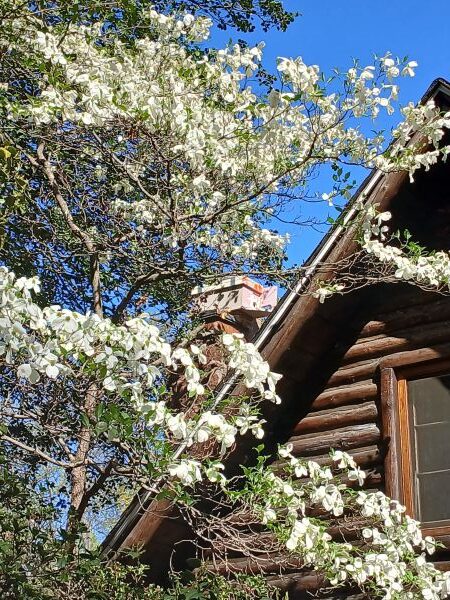
First thing we did was set a bait hive up on the chimney of the new Ancestral Knowledge Museum and Primitive Skills Research Center. The bait hive we used was a box with 6 frames with a few with old natural comb from some other hives. He also put some queen bee pheromones on a Q-tip that he place in the box. the box was strapped up to the chimney so it couldn’t fall. Stefano was downloading all sorts of information through the whole process, I wish i had a note pad.
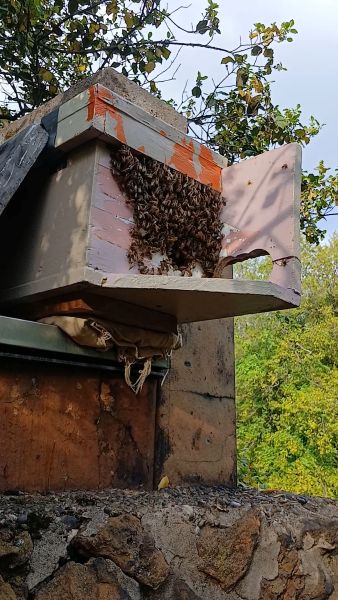
The day after we set up the bait hive I had to go to the Mid Atlantic Primitive Skills Gathering site to start setting up. When I came back to the cabin, to my delight, i noticed the box was covered in bees!!! We attracted a swarm!

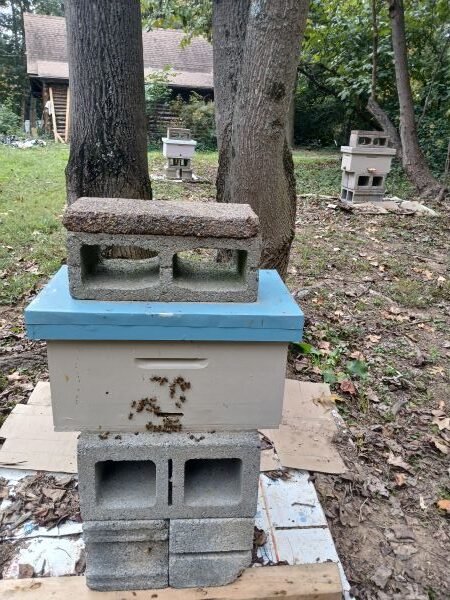
Now that we have a swarm of bees, we needed to move them from the chimney to the ground. The bees have been in their new home for over a week so this was a very slow process. We had to move it off the chimney to the roof first, allowing the bees to find its new position, then to the edge of the roof, then to the ground, then across the yard. After about 6 weeks and 6 moves, it was finally in its final resting place.
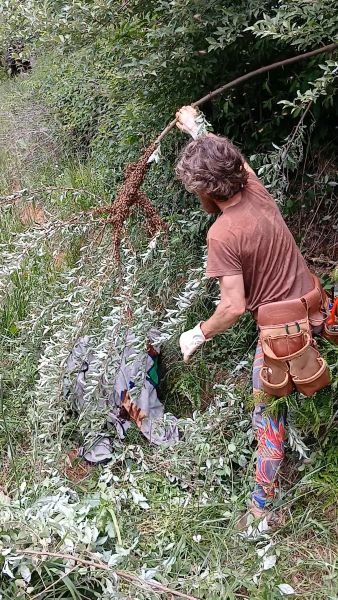
Meanwhile I visited my other buddy Tony at Red Sun Tea company in Asheville NC. He has an amazing apiary that pollinates his tea plants. I went there to tell him about my exciting new hobby, and absorb any tidbits of knowledge he wanted to drop for my. While I was there, one of his colonies split and swarmed, so I was able to help catch a swarm and put it into a new hive. What a crazy experience, to be completely engulfed in bees flying all around us, landing on our faces and bodies, and not stinging us.
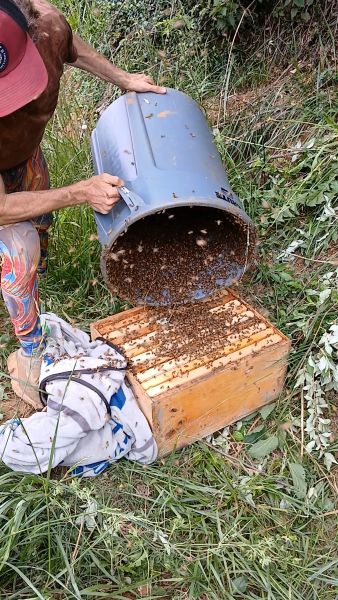
The bees swarmed and gathered on a branch about 12 feet off the ground in a small tree that we could bend down over a large trash can. With one big, jolting shake the swarm fell in a big clump into the large trash can below it. One of the neatest things about this, besides standing in the midst of 1000’s of bees going absolutely crazy, was the transfer from the can to the hive box. As Tony lifted the trash can and slowly dumped it over the hive box, the bees poured out of the trash can like a liquid, flowing in waves as they rolled out of the can into the hive box. It was mesmerizing. I was so excited to go home to visit with my new bee friends.
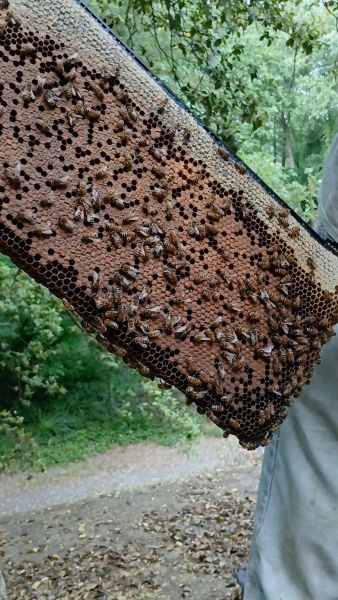
I came back to my new swarm, fired up to become their buddy. Every couple days I would go out and open the hive, let the bees land on me, letting them get a feel for who I am and that I was not a threat. Over the next couple of months I would randomly go out and watch their vigorous activity, leaving and returning with pollen packed legs, observing their different dances they did and trying to learn from their behaviors. One of my favorite things to do was put my face near the entrance and just breath in the sweet earthy smell that emanated from the hive. One day, my son and I opened the hive and pulled out the individual frames to see if we could find the queen. Early on Stefano and I couldn’t locate here, so I had yet to meet her. As we pulled frames and carefully observed, Nick spotted her. I couldn’t have been any happier about this journey that I had set out on.
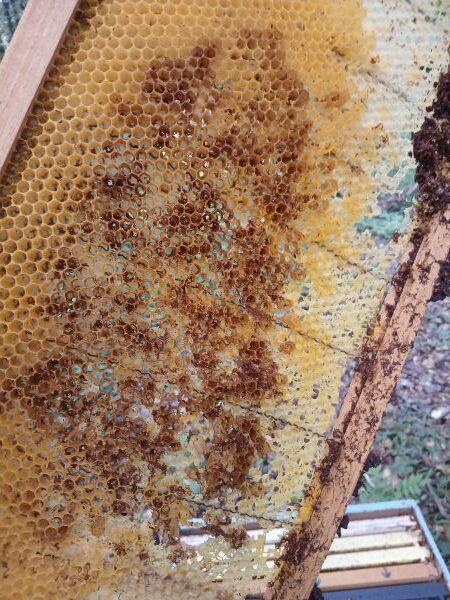
After a while Stefano told me that I should start feeding the bees to help prepare them for the winter. He talked me through how to do that and I set up a feeding bag in the top of the hive. The bees took to it immediately. a couple weeks went by and I added more food, it was all natural honey from Stefano. I went out one day to check on its supply and I immediately noticed that there wasn’t as much activity, as I approached the hive I could smell this odd, fermentation like smell. When I opened up the hive there were no bees, no honey, just larvae and beetles. All of the honeycomb was dry and half gone.

The hive had been raided by other bees and infested with wax moths and hive beetles. I was at a complete loss of words, the feelings I was experiencing were like none I had felt before, anger and sadness jumbled together stirring in my head. I called Stefano and he said, yeah, welcome to the beekeeping journey. He shared that the way to be a successful beekeeper is to have many hives as invasions, collapse, and other things contribute to the failure of a hive and the more you have the more successful you will be.
I found something in common between Stefano and Tony, that commonality is that they both focus on capturing and raising wild bees that are untreated with strong genetics. Neither of them where the classic Bee Suits, and Stefano doesn’t use smoke to subdue them. They both stay very calm and move very slowly and deliberately. Watching them work on hives is pretty amazing to see.

Since the loss of my first swarm, Stefano has brought me 3 more hives to tend over through the fall and winter. I am looking forward to more learning experiences and adventures with the bees.

If you or a friend has been wanting to explore the world of beekeeping, Stefano is teaching a workshop in October here at the Ancestral Knowledge. You can join me and we can journey together as he shows us how he works his magic and shares what he knows about the art of beekeeping.

This post was submitted by our Executive Director, Bill Kaczor
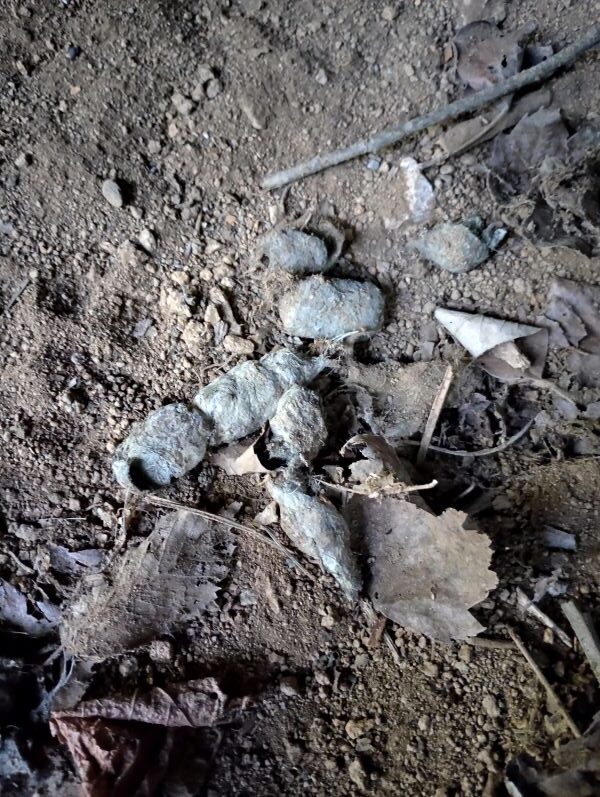
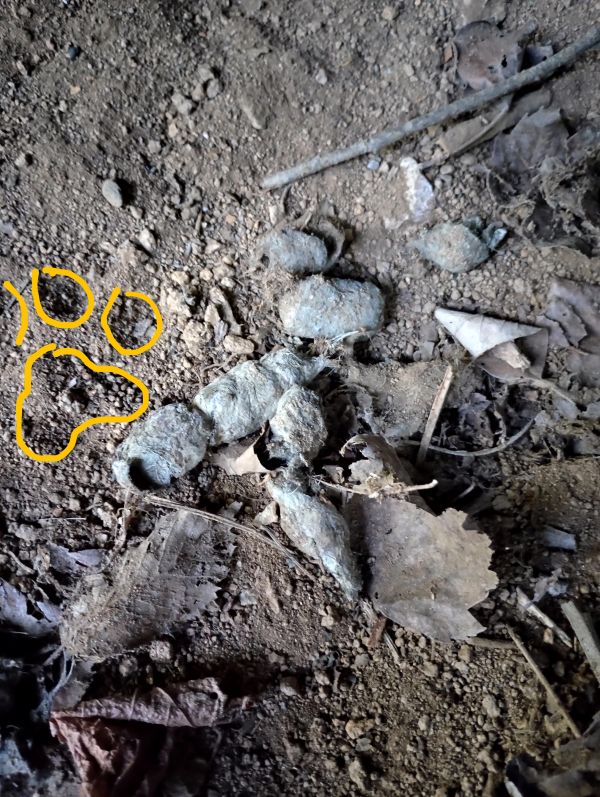
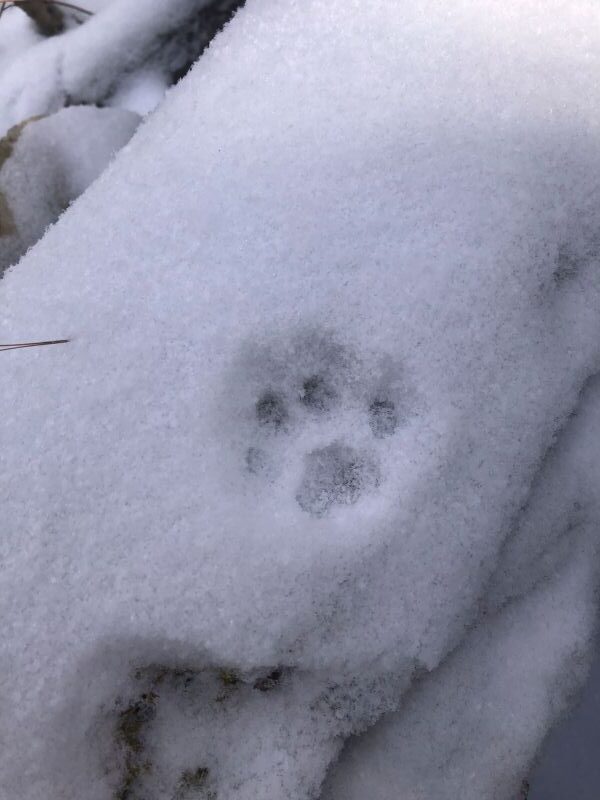
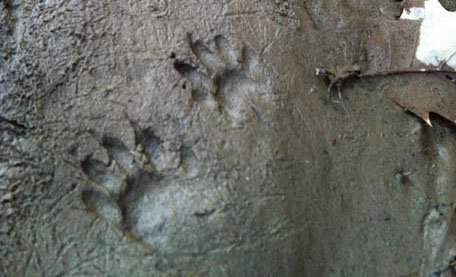
Tracking: A Story Waiting to be Read

“Tracks occur where the sky touches the earth” The Tracker – Tom Brown Jr

I have this vivid memory of taking a cardboard box, some string and a carrot into the woods across the street from my house.  As seen in the cartoons, I found a stick, tied the string to it and propped up the box with the stick and put the carrot underneath.  With the opposite end of the string in my hand, I laid in the brush several feet, watching, waiting.  I don’t remember how long I laid there, but I had nothing better to do, so it was quite a while. I was feeling good about this attempt as cartoons made it very clear that carrots were a rabbits preferred food, not to mention I would always see rabbits along the edge of the woods. I was hoping one would come along and go for the carrot at which point I would pull the string and trap it under the box.  To my surprise, and disappointment, nothing came and I didn’t understand why.

If only my grandfather, or even my “great” “great” grandfather had been taught the old ways of their “great” “great” grandfathers, so that my father could pass them onto me.  But unfortunately, that is not my history.  However I had this deep passion to learn the old ways at a very young age. 

Life went on, time passed, and thanks to the skills my father possessed and could pass on, I learned the ways of being a successful “modern” man, modern awareness and how spot the predators of the city and suburbs.  Then one day, thirty years ago, I read a book changed my life.

I was given a copy of The Tracker written by Tom Brown Jr. I couldn’t put the book down. Next thing I knew read his next 5 books and had a more questions about who I was and what is our purpose as humans on this earth.  At the end of each book there was a note in the back saying something along the lines of “if you’re interested in learning more about these skills, contact the Tracker School…”

Without telling the long version of the story, I ended attending the Standard class (a level 1 class) at the tracker school.  There I learned, with 125 others, the sacred order of survival and our basic needs to live; shelter, water, fire, and food.

During the standard Tom taught hours and hours of animal tracking, down loading enough information to fill a college credit course.  I couldn’t believe how much information was stored in a single track on the ground. Throughout the week It became very clear Toms passion was tracking and he was a tracker.

Reading that book, finding the Tracker School, and attending that class filled a void within my being that I had no idea existed.  Everything about my childhood started to make sense.  My passions, how I learned, the things that made me feel alive all came together within my being and I began to feel complete, with a drive to learn more about who I am and what my purpose was through learning the “old ways”. 

Tom said, “tracking is like reading a book, there is a story that is being told with each track being a word, The trail a paragraph, and the story ends when you find the final track.” He also said “when you’re tracking an animal, you become the animal and begin to “see through their eyes,” living their story.”

With each track you can learn so much. How fast they were moving, which way were they looking, if they were comfortable or on alert, hungry or satiated and so much more. The more you more you track, the more questions you ask, the more you ask more becomes apparent, sentences, and paragraphs of the story would become clearer. If only I was taught how to read tracks at the same time, I was introduced to the written word… if only.

Bill Kaczor – Director/Co-founder

Ancestral Knowledge Battles Against Nature Deficit Disorder

Our main goal here at Ancestral Knowledge is to bring the inner-city youth back to nature through programs like the ancient skills demonstrations we have held at the Washington D.C.’s Capital Hill Day School and other youth focused programs.  In addition, we help maintain connections to nature with adults through our partnership with the Wilderness Survival program a Georgetown University.  And, have provided experiences to adults who have lost touch with their childhood memories of the outdoors and want to regain that healthy relationship. Our youth and adult programs are helping reduce Nature Deficit Disorder.  We have seen some of the results with the kids we have continual contact with and it is encouraging.

Nature Deficit Disorder?

Almost two years ago the National Conservation Training Center in Shepherdstown, West Virginia, hosted the National Dialogue on Children and Nature Conference. The focus of the conference was on saving our children from nature deficit disorder. You may have heard of this phrase before, it is the title of a book by Richard Louv, Last Child in the Woods: Saving Our Children from Nature Deficit Disorder.  Louv in his acclaimed book argues that today’s children have lost their connection to the natural world because of the addictive character that the modern world of television, computers and video games has on our children.

Some of the actions, solutions, and opportunities that the conference participants suggested are still useful, but we have not seen much progress in making them reality other than limited research on the benefits of exposing children to nature.

Health-related actions: Conduct research on the benefits of exposing children to nature instead of pharmaceuticals; incorporate the health benefits of nature into medical and nursing school curricula; and encourage pediatricians to prescribe nature time for stress reduction and as an antidote to child obesity.

Education actions: Assure that every school utilizes nearby; offer students in-nature time during teacher in-service days; create new partnerships between schools, farms, ranches and public parks; establish a national Nature Bee; and ask each student to be personally responsible for one living thing.

Societal actions: Create a “Take a Child to Nature” day; persuade AARP to create a nature-mentor program; establish a child-nature impact assessment for all built environments; and engage religious organizations.

Locally, AK has been fruitful in establishing at least one of the possible solutions–ancient skills educational and nature programs–to local schools and universities. Parents can have a voice too by calling teachers, school boards, and congressional representatives to encourage more funding and focus on getting our children out in nature and, of course, signing up their children for outdoor experiences.

Let’s work together for a better future.

Travel Without Time or Destination!

So many people talk about wanting to connect with nature, achieving oneness, or grounding themselves. There are so many programs and organizations advertising nature connection (we sure have them). I don’t want to be the bearer of bad news, but in my opinion no program or workshop can make that happen, it’s too personal of a journey.  However, I do believe that workshops and programs can lead you to the trail head, point you in a direction, or give you the vehicle to get you there, but there is a catch!  It definitely isn’t as easy as a click of a mouse and it won’t happen overnight!  I can say, learning wilderness skills and increasing my awareness have been part of the best years of my life! When I experienced the feeling of oneness and connection for the first time it was only for a moment!  And it wasn’t in a program or class, it was with a group of friends practicing what we learned from a program we all had attended.  Once you experience it, what then?  You want more, you need more, you want it to last longer, but how?  In my experience I have found that I feel one with the earth, myself, and connected to those around me when I am regularly working on skills and projects from the days of our ancestors. Whether it’s bow making, animal tracking, or studying wild plants, these skills form a direct connection to the earth, our ancestors, and our deeper selves. Another way to achieve this is by venturing out without time or a destination.These traditions are some of the keys that open the doorways to the past, present, future & inner peace! Take the journey, leave the watch and phone behind. Learn to travel without time or destination and most importantly enjoy yourself!

At Ancestral Knowledge we are dedicated to helping people find their passions!  If you would like to get started on the personal journey of a lifetime let me know how we can help you get started. 
Thanks for reading!
Bill
PS-  Check out one of our programs below! They are perfect for all skill levels from beginner to advanced.  They will surely add some fun and adventure to your life!