
I have always been amazed by pollinators and now that we have a great place to house some bees, I put the call out to my friend who has been sharing his honey and wax with me for years. This Spring my buddy Stefano, from Azure Bee Apiaries, helped me catch my first swarm of honey bees.
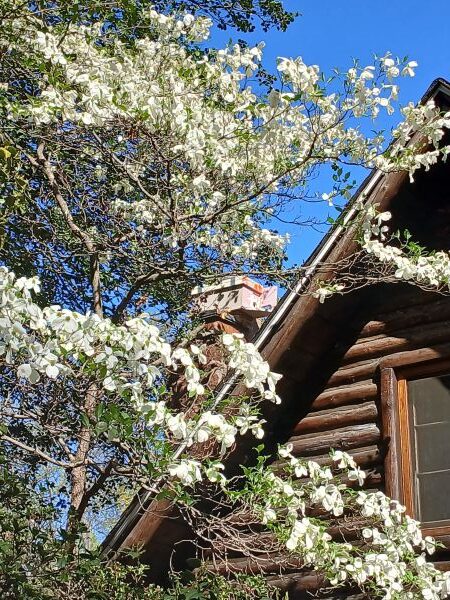
First thing we did was set a bait hive up on the chimney of the new Ancestral Knowledge Museum and Primitive Skills Research Center. The bait hive we used was a box with 6 frames with a few with old natural comb from some other hives. He also put some queen bee pheromones on a Q-tip that he place in the box. the box was strapped up to the chimney so it couldn’t fall. Stefano was downloading all sorts of information through the whole process, I wish i had a note pad.
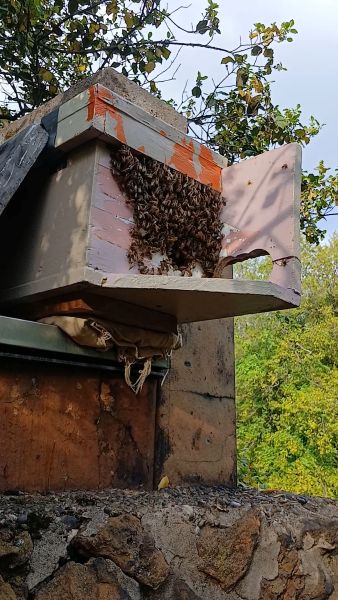
The day after we set up the bait hive I had to go to the Mid Atlantic Primitive Skills Gathering site to start setting up. When I came back to the cabin, to my delight, i noticed the box was covered in bees!!! We attracted a swarm!
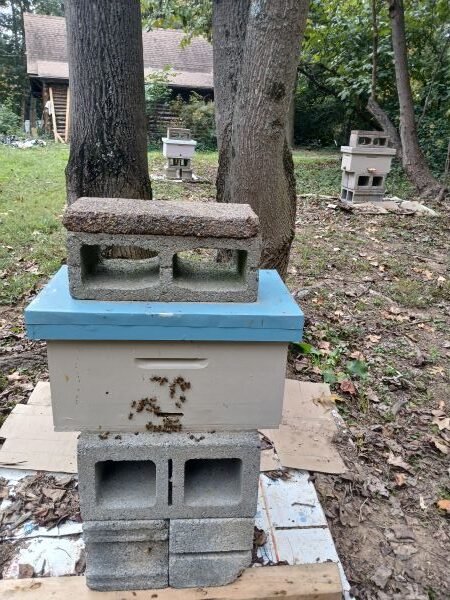
Now that we have a swarm of bees, we needed to move them from the chimney to the ground. The bees have been in their new home for over a week so this was a very slow process. We had to move it off the chimney to the roof first, allowing the bees to find its new position, then to the edge of the roof, then to the ground, then across the yard. After about 6 weeks and 6 moves, it was finally in its final resting place.
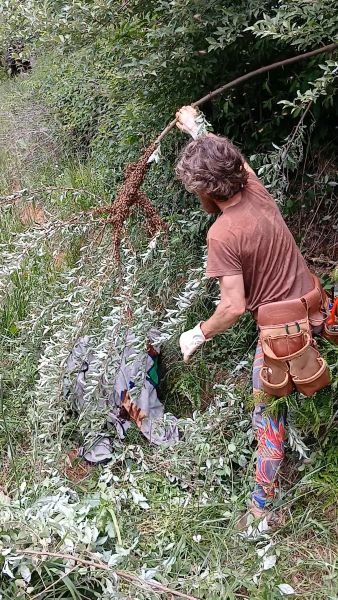
Meanwhile I visited my other buddy Tony at Red Sun Tea company in Asheville NC. He has an amazing apiary that pollinates his tea plants. I went there to tell him about my exciting new hobby, and absorb any tidbits of knowledge he wanted to drop for my. While I was there, one of his colonies split and swarmed, so I was able to help catch a swarm and put it into a new hive. What a crazy experience, to be completely engulfed in bees flying all around us, landing on our faces and bodies, and not stinging us.
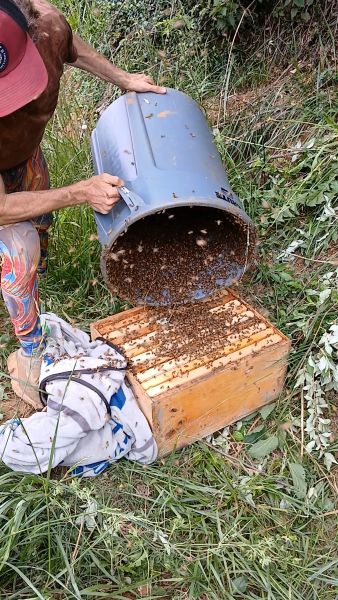
The bees swarmed and gathered on a branch about 12 feet off the ground in a small tree that we could bend down over a large trash can. With one big, jolting shake the swarm fell in a big clump into the large trash can below it. One of the neatest things about this, besides standing in the midst of 1000’s of bees going absolutely crazy, was the transfer from the can to the hive box. As Tony lifted the trash can and slowly dumped it over the hive box, the bees poured out of the trash can like a liquid, flowing in waves as they rolled out of the can into the hive box. It was mesmerizing. I was so excited to go home to visit with my new bee friends.
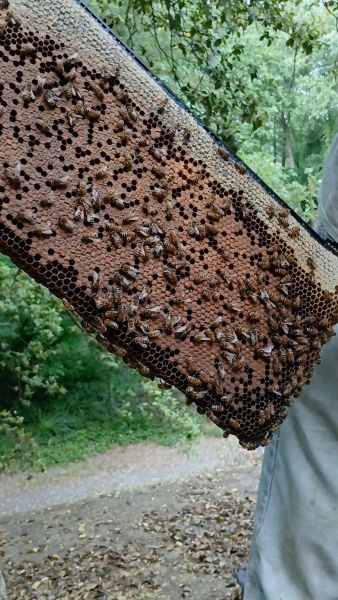
I came back to my new swarm, fired up to become their buddy. Every couple days I would go out and open the hive, let the bees land on me, letting them get a feel for who I am and that I was not a threat. Over the next couple of months I would randomly go out and watch their vigorous activity, leaving and returning with pollen packed legs, observing their different dances they did and trying to learn from their behaviors. One of my favorite things to do was put my face near the entrance and just breath in the sweet earthy smell that emanated from the hive. One day, my son and I opened the hive and pulled out the individual frames to see if we could find the queen. Early on Stefano and I couldn’t locate here, so I had yet to meet her. As we pulled frames and carefully observed, Nick spotted her. I couldn’t have been any happier about this journey that I had set out on.
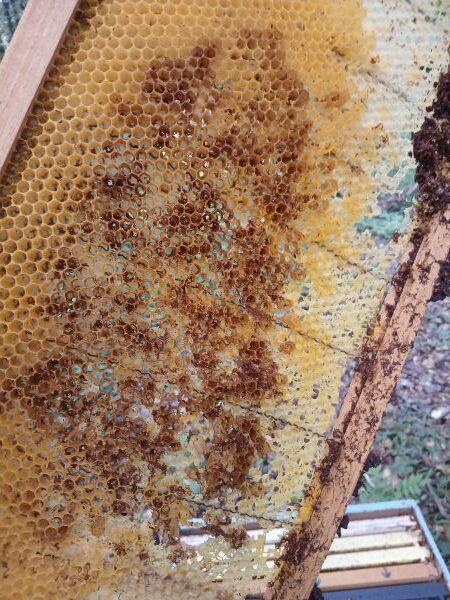
After a while Stefano told me that I should start feeding the bees to help prepare them for the winter. He talked me through how to do that and I set up a feeding bag in the top of the hive. The bees took to it immediately. a couple weeks went by and I added more food, it was all natural honey from Stefano. I went out one day to check on its supply and I immediately noticed that there wasn’t as much activity, as I approached the hive I could smell this odd, fermentation like smell. When I opened up the hive there were no bees, no honey, just larvae and beetles. All of the honeycomb was dry and half gone.
The hive had been raided by other bees and infested with wax moths and hive beetles. I was at a complete loss of words, the feelings I was experiencing were like none I had felt before, anger and sadness jumbled together stirring in my head. I called Stefano and he said, yeah, welcome to the beekeeping journey. He shared that the way to be a successful beekeeper is to have many hives as invasions, collapse, and other things contribute to the failure of a hive and the more you have the more successful you will be.
I found something in common between Stefano and Tony, that commonality is that they both focus on capturing and raising wild bees that are untreated with strong genetics. Neither of them where the classic Bee Suits, and Stefano doesn’t use smoke to subdue them. They both stay very calm and move very slowly and deliberately. Watching them work on hives is pretty amazing to see.
Since the loss of my first swarm, Stefano has brought me 3 more hives to tend over through the fall and winter. I am looking forward to more learning experiences and adventures with the bees.
If you or a friend has been wanting to explore the world of beekeeping, Stefano is teaching a workshop in October here at the Ancestral Knowledge. You can join me and we can journey together as he shows us how he works his magic and shares what he knows about the art of beekeeping.
This post was submitted by our Executive Director, Bill Kaczor
 Nature empowers females (Notice that we call her Mother Earth, not Father Earth.). Although there are certainly laws of nature that must be “obeyed,” we generally don’t think of the planet in paternalistic terms. It’s difficult to behold the abundance of life brimming forth from every nook and cranny of this bizarre space rock and not feel the power of the womb, and realize that the forces at play are the maternalistic ones of nurturing, caring, and giving.
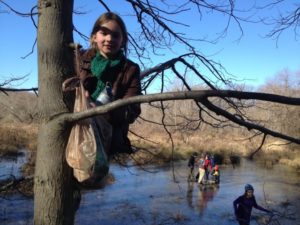 “So proud of my daughter, Sophia. She started off the week not sure if she wanted to go to Ancestral Knowledge Wood Wise I Camp, anxious at first that she was the only girl until a few more girls showed up. She came home every day with a layer of dirt and a smile on her face. Today she was so proud that she had earned her bead for going out in the woods alone, sitting quietly for half an hour, and observing animals. I’m grateful to the young women who were her role models as counselors this week. Sophia seems stronger and more confident. Ancestral Knowledge Camp seems to be an effective counter to princess culture. (See
 We encourage everyone to get out and enjoy the outdoors during the winter time. However everyone responds to cold temperatures differently. Keeping feet, hands, and clothing dry is very important because toes and fingers are most susceptible to damage from the cold. Whenever possible carry an extra pair of socks in case your feet get wet and a couple plastic shopping bags to put over the dry socks to avoid the boots saturating the dry socks. Wet feet, hands, and clothing need to be addressed in a timely fashion because wet clothing will cause you to lose warmth. If you get wet its best to get indoors or change those layers. If that’s not possible build a fire to warm up and dry out those wet clothes. Being prepared and dressing properly will allow for hours of winter fun and exploration!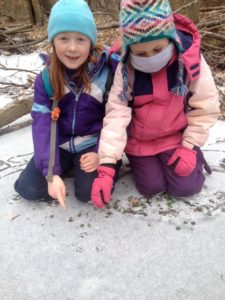
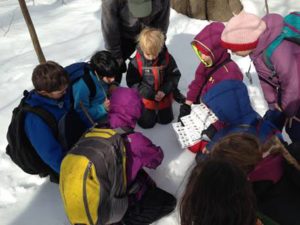 The Outer Layer (Outer winter coats and Snow pants) – The outer layer or shell should be waterproof, providing protection from wind, rain and snow. Waterproof shells typically have minimal insulation so they can be worn over the inner layers without being too balky . You’ll find outer shells in both jackets and pants, making them ideal for a number of cold-weather activities. Your winter coat should have a hood, be wind-resistant, water-repellent and breathable. Down jackets, filled with goose feathers, are excellent for warmth but need to be protected in wet weather with a rain jacket. Fleece-lined ski jackets are excellent also. One-piece snowsuits might be appropriate for kids who spend all day outdoors in the winter. Snowsuits are highly water-resistant and provide the maximum protection from the wet snow.