
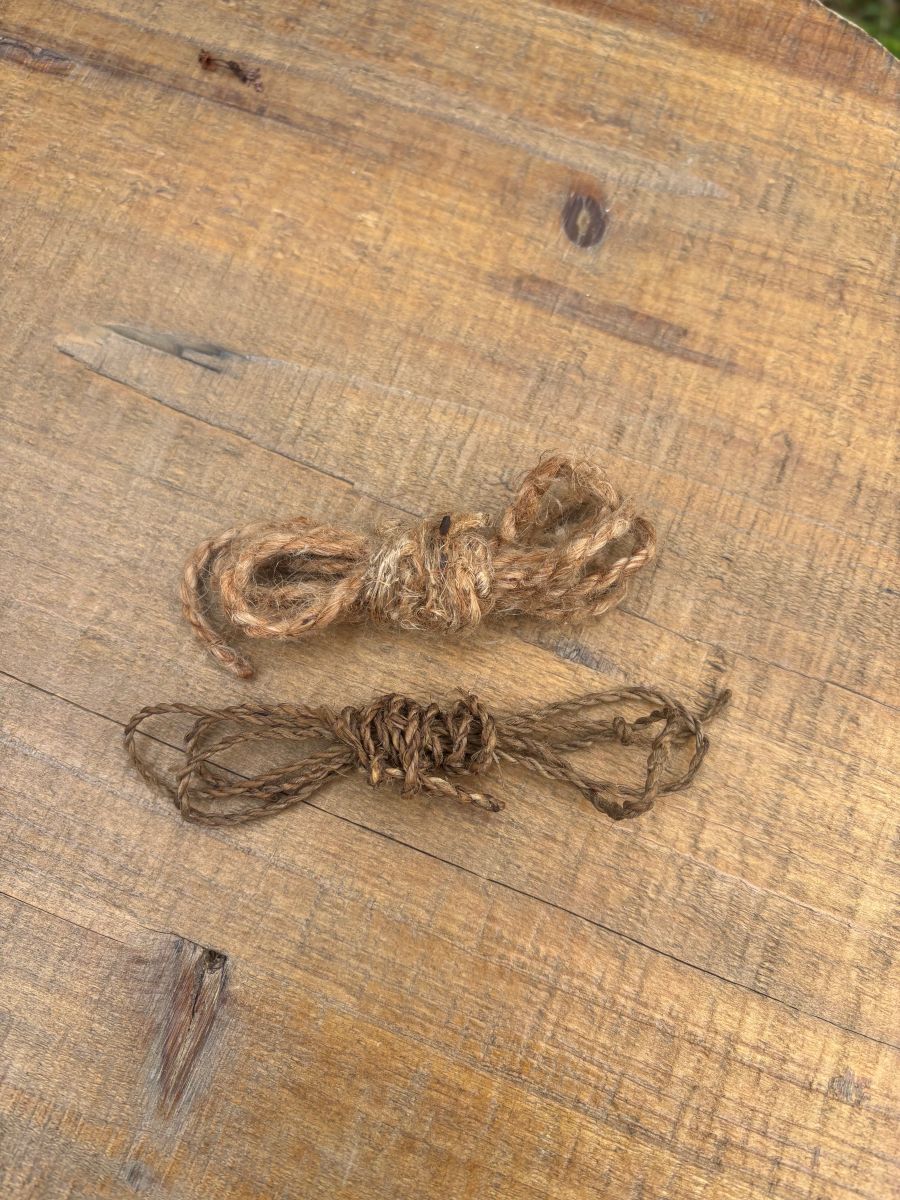
As we move into the cooler months, we’re all looking to spend more time outdoors. Increasingly, one of my favorite ways to connect with nature is by making cordage with natural materials. Cordage or rope making has been one of humanity’s fundamental skills since prehistory. Outside of survival uses like shelter building, fishing line, and bowstrings, simple rope has been instrumental in seafaring, construction, and even mathematical calculations.
I find hand twisting simple 2-ply cord to be incredibly relaxing, it clears my head and keeps my hands busy. It truly feels like what your hands are meant to do. By learning the local plants to use this skill with, I have been able to develop a tactile connection with nature that I wish to share.
Below is my guide to some of my favorite materials cordage I’ve found around the DC-Maryland area:
Wisteria:
You either know this vine for its large purple drooping flower or being one of the most destructive, tree-killing invasives on the east coast. What you might not know is that the vines hold an incredibly strong inner fiber.
Where to find it: ANYWHERE. Roadsides, forests, suburban parks, your backyard. This stuff is incredibly invasive. I find that the ground runners work best but whenever I can I try to cut wisteria off from trees.
How to process it: After cutting down the vine,I find that the easiest and fastest way to process the fibers is by making two shallow cuts at the cut end with a pair of clippers in an X pattern. This allows you to get your fingernail under the bark and start peeling. Once you’ve finished peeling, you can scrape away the outer bark with a knife and then separate the fibers lengthwise.
Dogbane:
If you were a Native American living here 1000 years ago, this would be your fiber of choice. Dogbane( also called Indian hemp due to its use in ropemaking) is an incredibly widespread perennial plant native to North America. Due to this and the high tensile of its fiber, dogbane was used for everything from bowstrings to nets to bags on this continent. All parts of the plant are highly toxic when ingested to most animals including humans by way of the cardiac glycoside, apocynamarine, which can cause cardiac arrest. But unless you plan on eating your rope, this is not a concern.
Where to find it: Dogbane likes wet soil and direct sunlight. Look in open fields, hillsides, and weedy roadsides. Dogbane is best harvested dead in the fall. I like to clip off any branches off the stem for easier transport, I always leave the seed pods in tree branches to help the seed better disperse.
How to process it: Take the woody stem and crush it flat using either your hands or a hard surface/rock depending on the strength of the stem. Afterwards, split the stem down the middle, you will now have four segments. You then break the woody stem away from the fibers in one direction and peel away in the opposite direction. For a finer cordage you can remove the outer red bark from the inner fibers, the easier way to do this is just by rubbing the fiber in your hands.
Pawpaw:
The pawpaw may be the ultimate survival tree. This small understory tree is native to most of the southeast and has become increasingly popular with foragers and gardeners The pawpaw fruit is high calorie and packed with nutrients, the wood makes for an amazing friction kit, and the inner bark makes for an incredible cord.
Where to find it:
Pawpaws grow in rich moist soil, I commonly find them on the slopes of floodplains, creeks, and marshlands. Something to note is that pawpaws grow in a type of grove called a clonal colony; meaning you can usually find dead standing trees among the living ones.
How to process it:
I look for dry standing dead pawpaw trees, ideally the bark should peel right off the wood. You can then simply peel the inner fiber away from the bark. Another possibility is collecting the bark green and retting it in water. Retting is the process of separating fibers by way of a controlled rot. This should be done for at least a day but your results may vary.
Now those were just a few plants I have experience with in the area but there are dozens more! Some that I would also look out for include: Evening Primrose, Stinging nettle, marsh mallow, and Milkweed. So get out, explore, learn a new plant and twist some cord!
BLOG Post was submitted by our field instructor Ben Kamm