

In the built world, things are designed to be efficient, immediate, and visible only at the point of use. You flip a switch and get light. You open a package and get food. Systems are hidden behind walls or outsourced entirely. There’s little invitation to notice process—or pattern.
But in nature, pattern is the story.
Everything living is part of a cycle. Growth and decay. Movement and rest. Heat and cold. Nothing exists without its opposite. These aren’t abstractions—they’re practical realities that shape how life functions.
A rotting log feeds fungus, beetles, and soil. The fallen branch that blocks a deer trail may offer cover to a rabbit. A predator’s movement can be read in the sudden stillness of other creatures. The richness of spring depends on the dormancy of winter. In wild systems, nothing stands alone.
This is duality—not conflict, but interdependence. Each condition is shaped by its counterpart.
By contrast, in the human-built world, we often only experience one half of the cycle. We enjoy the fruit, but don’t see the years of root growth. We access warmth without storing wood or tending fire. Food is harvested, cleaned, transported, and presented with all other evidence removed. When only the final product is visible, we lose sight of what created it—and what it will become.
This makes it hard to think in systems. And it makes it even harder to adapt when systems change.
Systems thinking is the ability to recognize relationships over time. Instead of asking “What is this?” we begin to ask, “What is this connected to?” and “What shaped this?”
This way of thinking isn’t built by speed or isolation—it’s shaped by observing slow change, feedback loops, and interdependence. And it’s one of the most important perceptual skills we can build.
In a forest, systems thinking becomes natural. You start to notice that soil texture shapes water flow, which influences plant growth, which shapes the density and diversity of insect life, drawing in some birds while deterring others, depending on the conditions. That a shift in canopy structure after a storm changes light levels, which leads to a flush of different understory species. That a well-worn trail through the understory becomes a corridor for smaller animals, whose presence eventually draws in predators from above and below.
Over time, these relationships begin to surface as memory.

I’ve worked in the same patch of woods for nearly a decade. In that time, I’ve watched entire plant successions unfold in ways you wouldn’t notice unless you returned again and again to the same spot. For years, lesser celandine carpeted the stream banks each spring, spreading across the saturated low ground as one of the first green-ups. But in recent seasons, Japanese hops have begun to appear—an invasive climber now overtaking the celandine in areas where scouring water or seasonal disturbance exposed fresh bank soil.
It’s not random. It’s pattern. New disturbance opened a niche, and a different plant moved in. And that shift will in turn affect insect populations, ground cover dynamics, and even how the bank holds in the next big rain. Nothing changes alone.
Tracking offers one of the clearest ways to train this type of perception.
It starts simply: a single print in soft earth. But quickly, it becomes more layered. You begin to notice the direction of travel, the spacing between steps, the depth of pressure and how it shifts. A wide stance, a staggered stride—these suggest something about speed, awareness, decision-making.
With time, you stop looking just at the track and start looking at the surrounding story. What vegetation was brushed or bent? Did the trail cross elevation, edge habitat, or a water source? Where did the movement pause, change gait, or disappear into heavier cover? What changed in the land after the animal passed?
The more you follow, the more the trail teaches. You learn to hold multiple possibilities at once. You learn to recognize when you’ve lost the trail—and how to recover it. You start to feel the rhythm of motion across landscape, and how much is communicated through absence as well as presence.
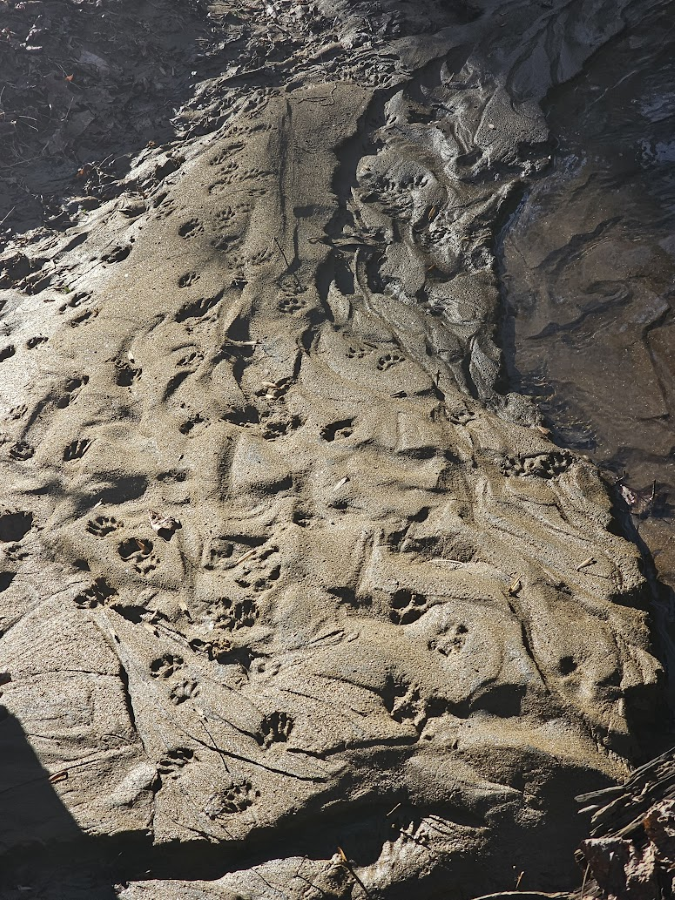
Tracking isn’t a test of identification—it’s a practice of relationship. It forces you to widen your lens, to notice indirect sign, to keep circling back. It teaches humility. And it steadily builds the kind of perception that can read systems in motion, not just isolated events.
If you’d like to begin, find a patch of ground that holds subtle detail—wet sand, light snow, leaf duff after rain. Look for any sign of movement: a partial track, a compressed leaf, a spot where something brushed through. Rather than jumping to answers, stay with the question. Where did it come from? Why did it go that way? What terrain was chosen—and what was avoided? What changed along the path?
Let yourself slow to its rhythm.
Duality is everywhere—stillness and movement, imprint and lift-off, growth and return. Systems thinking means noticing both, and the pattern that forms between them. And that kind of perception can’t be rushed. But it can be trained.
Blog Post Submitted by Eden Cornelous – Lead Field Instructor